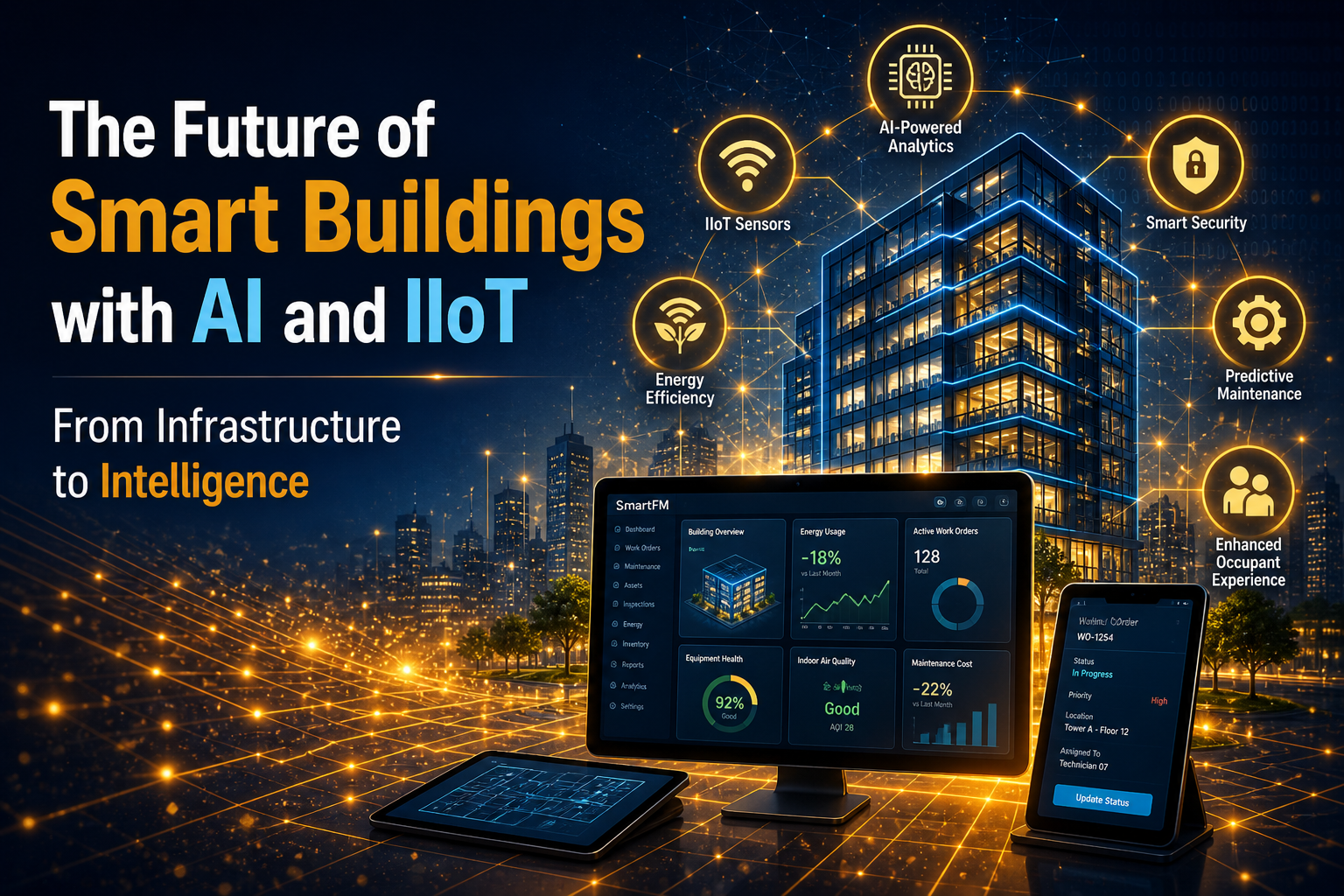
Buildings are no longer just physical structures.
They are evolving into intelligent ecosystems that can sense, analyze, and respond to real-time conditions.
From commercial towers and hospitals to airports and smart cities, modern infrastructure is becoming increasingly connected and data-driven.
Artificial Intelligence (AI) and Industrial Internet of Things (IIoT) are at the core of this transformation.
These technologies are redefining how buildings operate, shifting from manual and reactive systems to automated, predictive, and intelligent environments.
What is a Smart Building?
A smart building is a facility that uses digital technologies, sensors, and automation systems to monitor and manage operations in real time.
These buildings integrate multiple systems such as:
- Facility management platforms
- Building Management Systems (BMS)
- IoT sensors and devices
- Energy management systems
- Security and access control systems
- Data analytics platforms
The goal is to improve operational efficiency, reduce costs, enhance occupant comfort, and support sustainability.
The Role of IIoT in Smart Buildings
Industrial IoT plays a critical role in enabling smart infrastructure.
IIoT sensors are deployed across buildings to collect real-time data from various systems.
These sensors can monitor:
- Temperature and humidity
- Energy consumption
- Equipment performance
- Occupancy levels
- Air quality
- Water usage
This continuous data flow provides complete visibility into building operations.
Instead of relying on periodic inspections, facility teams can monitor everything in real time.
The Role of Artificial Intelligence
While IIoT collects data, AI transforms that data into actionable insights.
AI systems analyze patterns, detect anomalies, and make predictions that help optimize building performance.
AI enables:
- Predictive maintenance
- Energy optimization
- Automated fault detection
- Intelligent scheduling of operations
- Real-time decision-making
For example, AI can detect early signs of equipment failure and automatically trigger a maintenance request before a breakdown occurs.
From Reactive to Predictive Operations
Traditional facility management is reactive.
Equipment is repaired after failure, inspections are scheduled manually, and decisions are based on past data.
Smart buildings operate differently.
They use real-time data and predictive analytics to anticipate issues before they occur.
This shift results in:
- Reduced downtime
- Lower maintenance costs
- Improved asset lifespan
- Higher operational efficiency
However, many organizations still believe they are digital because they use modern tools, while their core processes remain manual and disconnected. This gap between tools and actual transformation is often referred to as digital decoration.
True smart buildings require connected systems and integrated intelligence.
SmartFM and Intelligent Facility Management
SmartFM plays a key role in enabling smart buildings by integrating AI, IIoT, and facility management into a single platform.
SmartFM connects:
- CAFM and CMMS systems
- IoT sensors and devices
- Energy management systems
- Compliance and inspections
- Mobile workforce applications
This allows organizations to manage buildings through a centralized digital ecosystem.
For example:
- Sensors detect abnormal energy consumption
- SmartFM analyzes the data
- The system identifies inefficiencies
- A work order is automatically generated
- The technician receives the task via mobile app
This creates a fully connected and automated operational workflow.
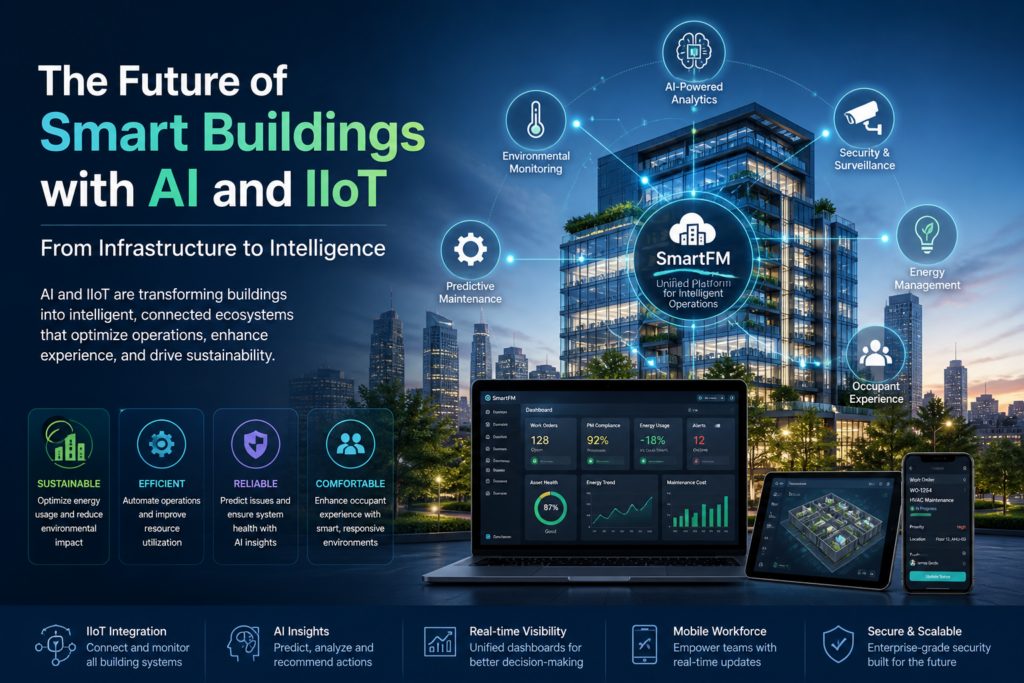
Benefits of Smart Buildings with AI and IIoT
Organizations adopting smart building technologies gain significant advantages.
Improved Energy Efficiency
Real-time monitoring helps reduce energy waste and optimize consumption.
Predictive Maintenance
AI detects potential failures before they happen, reducing downtime.
Enhanced Occupant Experience
Smart environments improve comfort, safety, and convenience.
Better Operational Control
Centralized dashboards provide full visibility across all systems.
Sustainability and ESG Compliance
Smart buildings support environmental goals through optimized resource usage.
Use Cases Across Industries
Smart building technology is being adopted across multiple industries.
- Commercial real estate
- Airports and transportation hubs
- Hospitals and healthcare facilities
- Hotels and hospitality
- Universities and campuses
- Manufacturing and industrial facilities
- Government and smart city projects
Each industry benefits from improved efficiency, automation, and real-time control.
The Future of Smart Buildings
The next phase of smart buildings will go beyond automation.
Future developments will include:
- Autonomous building systems
- Digital twins for infrastructure
- AI-driven decision-making
- Fully integrated smart city ecosystems
- Advanced sustainability and carbon tracking systems
Buildings will not only respond to conditions but will continuously learn and optimize themselves.
Smart buildings are redefining the future of infrastructure.
AI and IIoT technologies are transforming buildings into intelligent systems that can monitor, analyze, and optimize operations in real time.
Organizations that adopt these technologies will gain a competitive advantage through efficiency, cost savings, and improved sustainability.
Platforms like SmartFM enable this transformation by connecting systems, automating workflows, and providing real-time insights.
The future of buildings is not just smart.
It is intelligent, connected, and continuously evolving.
Frequently Asked Questions
What is a smart building?
A smart building uses digital technologies, sensors, and automation systems to monitor and manage operations in real time.
What is IIoT in facility management?
IIoT refers to connected sensors and devices that collect real-time data from building systems.
How does AI help in smart buildings?
AI analyzes data, predicts failures, optimizes energy usage, and automates building operations.
What are the benefits of smart buildings?
Smart buildings improve efficiency, reduce costs, enhance occupant experience, and support sustainability.
How does SmartFM support smart buildings?
SmartFM integrates AI, IoT, maintenance, compliance, and operations into a single platform for intelligent facility management.